Forest Gate House Clearance — Health & Safety Policy
Purpose and commitment
The purpose of this policy is to set out how Forest Gate house clearance operations are managed to protect workers, clients and the public. Forest Gate House Clearance and related rubbish removal services commit to reducing risk by applying clear procedures, competent staff and appropriate equipment during every clearance, rubbish collection and waste removal activity. This policy applies to all employees, contractors and temporary workers engaged in house clearances and associated waste-handling tasks.Scope
This policy covers typical domestic and small commercial clearances, haulage of household waste, recycling sorting and site tidying at properties where rubbish company service area activities occur. It acknowledges the range of hazards encountered during clearances including manual handling, sharps and hazardous materials, dust, pests, slips, trips and vehicle movements. All operational decisions will balance efficient bulky rubbish removal with the highest practicable health and safety standards.
Responsibilities
All staff are responsible for following safe systems of work. Managers must ensure adequate training, supervision and resources. Key responsibilities include:- Risk assessment: Conduct pre-task surveys and dynamic checks on arrival.
- Training: Provide manual handling, PPE, and waste awareness training.
- Reporting: Record incidents and near-misses and ensure corrective action.
Risk assessment and planning
Before any house clearance or rubbish removal job, a documented risk assessment will be completed. Assessments consider access constraints, staircase condition, number and weight of items, potential for hazardous substances (e.g. asbestos, chemicals), presence of sharps and vermin, and vehicle positioning. If a task is judged to be high-risk it will be planned with additional controls: more personnel, lifting aids, or specialist disposal routes.Safe systems of work
Safe systems include:
- Using mechanical aids (trolleys, sack trucks) to limit manual handling;
- Ensuring clear, unobstructed routes for moving waste and bulky items;
- Assigning a competent banksman for vehicle loading when required;
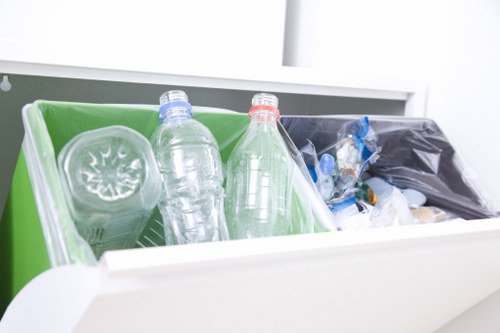
- Segregating recyclable materials and hazardous items for correct disposal.

Personal protective equipment (PPE)
Personal protective equipment is provided where risk assessment indicates necessity. Typical PPE for clearance work includes high-visibility clothing, sturdy gloves (cut-resistant where required), safety footwear, eye protection and dust masks. Staff must wear appropriate PPE during loading, sorting and handling tasks. PPE is maintained, inspected and replaced as required; fit and condition checks are part of daily pre-work routines.Control of hazardous waste and sharps
Clear procedures are in place for identifying and segregating hazardous items. Anything suspected of being hazardous (paint tins, batteries, solvents, asbestos-containing materials) will not be handled by general clearance teams unless trained and authorised. Sharps discovered during house clearances are collected using mechanical aids and placed in approved containers for safe disposal. When specialist waste removal is required, a licensed disposal route will be used to ensure legal and safe handling.Vehicle and on-site safety
Vehicles used for waste collection are maintained to a safe standard with regular checks on brakes, load security, lights and tyre condition. Site set-up considers pedestrian routes and public safety; cones or signage are used where necessary. Loads are secured to prevent shifting and spillage during transit. Drivers and loaders follow manual handling and vehicle safety best practice to reduce incidents.
Training and competence
Staff receive induction training covering manual handling, infection control, PPE use, hazardous materials awareness and safe driving where required. Regular refresher training, toolbox talks and scenario-based briefings help maintain competence. A record of training, certifications and medical fitness where relevant is kept to ensure that all personnel engaged in household clearance and rubbish collection duties are capable of performing their roles safely.Incident management and review
All accidents, near-misses and significant health concerns are reported and investigated promptly. Findings are used to update risk assessments and improve practises. The policy and associated procedures are reviewed at least annually or after any serious incident, change in legislation, or operational change affecting the rubbish pickup and house clearance activities.